


Compute becomes the product
When people discuss Nvidia, AI infrastructure and the next software economy, the topic is no longer only graphics cards or data centers. The market is selling compute, inference capacity, model access and, very often, tokens.
That is technically correct. But it only explains half of the current activity boom in software projects. The other half is psychological. Many developers are not experiencing AI coding as a finely metered resource right now. They experience it as something included in an existing plan.
The current GitHub commit explosion is not only a productivity signal. It is also a pricing signal.
When cost leaves the developer mind
Before the current AI coding flat-rate feeling, almost every GPT interaction had a visible or imagined cost. Developers asked themselves: Is this prompt worth it? Is this refactoring idea large enough? Should I really let the agent run another round?
Once Codex or a similar tool is included in a plan, behavior changes. The question is no longer: What does this attempt cost? The question becomes: What can the agent try next?
The local XvX workspace shows the scale for May 2026: 71 Codex sessions, 867,784,946 counted tokens and an estimated equivalent cost of about 4,840 US dollars. This is not an invoice. It is a cost projection from local usage statistics, and it makes the compute volume behind the flat-rate feeling visible.
- May 2026: 71 Codex sessions.
- Counted tokens: 867,784,946.
- Token events: 9,335.
- Estimated equivalent cost: about 4,840 US dollars.
- Models: 69 sessions with gpt-5.5, 2 sessions with codex-auto-review.
- Experiments feel cheaper.
- Refactorings start faster.
- Agents run longer across more files.
- Tests, documentation and boilerplate appear more often.
- Commit volume rises, even when product value still needs separate evaluation.
The screenshot is the point
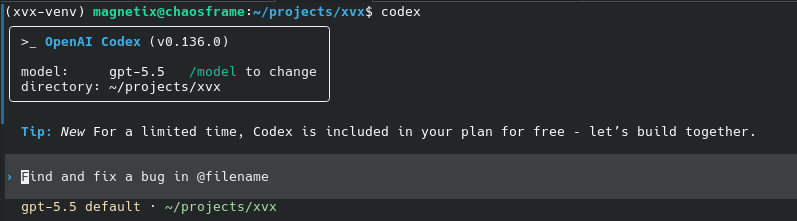
The relevant message in the Codex interface is simple: for a limited time, Codex is included in the current plan. That is not a small detail. It changes the developer's mental accounting.
When the tool itself says usage is included, work is planned differently. People let the agent analyze, rebuild, test, explain and iterate. Not because software suddenly became magically easy, but because visible token-cost friction went down.
GitHub metrics get blurrier
AI agents can create more file changes in 30 minutes than one human developer would previously have committed in several days. That can look like extreme productivity. Sometimes it is. But commit counts, generated files and repository activity have become less precise signals.
More commits do not automatically mean better architecture. More generated code does not automatically mean more product value. More refactoring does not automatically mean more clarity. What is certain is this: the cost barrier for software experimentation has been temporarily lowered.
The new software production economy
Nvidia provides the hardware foundation. AI providers sell inference access. Coding tools sell workflow acceleration. Developers receive, for a while, the feeling of unlimited generation.
The market is training developers to use AI not as occasional assistance, but as a permanent execution layer in the development process.
The important question is not: Are developers suddenly ten times faster? The better question is: What happens when AI coding becomes the default execution layer and token costs disappear from the developer's mental model?
The current AI coding wave should not be measured only by commits, generated files or repository activity. Those numbers are now influenced by agentic workflows and temporarily invisible token costs.
When Codex tells developers that it is included in their plan, behavior changes instantly. People stop asking whether a prompt is worth the money. They start asking what the agent can try next.
That is the real shift. Not just faster coding. A new software production economy.