

Safety Architecture
XvX exists for accountable AI automation.
n8n is strong for connecting APIs and building workflows quickly. XvX is different: it is designed as an auditable AI execution layer for real-world systems where security, traceability, data ownership, and controlled AI behavior matter more than convenience.
Positioning
Not a replacement for every automation workflow.
The goal is not to replace n8n everywhere. The goal is to provide a safer architecture for AI-assisted processes that must be understandable, reviewable, and accountable.
Why It Matters
Workflow automation alone is not enough for high-stakes AI.
Unclear Data Flow
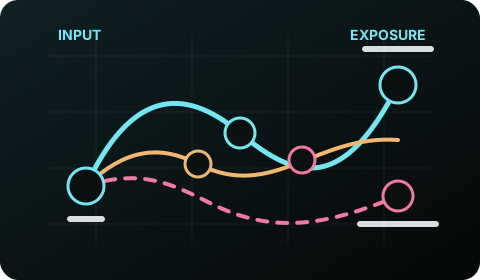
Complex AI workflows can move sensitive data through too many nodes, integrations, and third-party systems.
Secret Sprawl
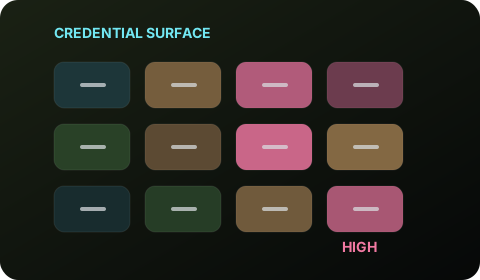
Credentials spread across integrations are harder to audit, rotate, and reason about over time.
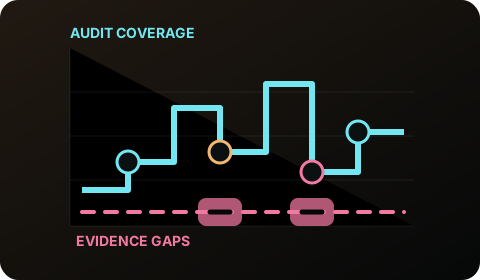
Weak Auditability
Visual workflow logic can become fragile and difficult to review after months of operational change.
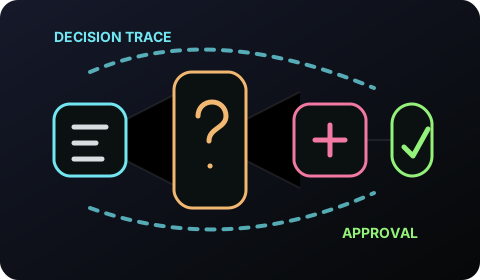
Opaque AI Decisions
Teams need to inspect why an AI decision happened, which input was used, and whether a human approved it.
Execution Model
XvX uses controlled AI routing instead of one large automation graph.
Skills, files, logs, prompts, metadata, and review steps are separated so every stage can be inspected, tested, versioned, and approved independently.
Input
-> OCR Skill
-> Classification Skill
-> Accounting Skill
-> Human Review
-> Export
Security Benefits
Designed to reduce blast radius and preserve human control.
Separation of Responsibilities
Input handling, AI processing, tool execution, storage, logging, approval, and external API calls can be isolated.
Local-First Operation
Sensitive documents, logs, medical data, invoices, and internal business data can stay on controlled Linux infrastructure.
Explicit Secret Handling
Credentials can live in controlled configuration such as settings/config.json instead of being spread across nodes.
Human Approval Gates
The AI may recommend an action while execution remains separate for accounting, legal, medical, infrastructure, or customer workflows.
Auditability
Evidence should survive beyond a workflow run.
XvX can store intermediate files, structured metadata, logs, prompts, and outputs so teams can reconstruct what happened, which system handled it, which model was called, and which version produced the result.
- Files
in/,out/,log/,memory/,settings/,skills/- Metadata
- JSON sidecars can record source files, routes, models, timestamps, and approvals.
- Git
- Workflows, prompts, skills, and configs can be versioned and reviewed.
- Testing
- Each skill can be tested independently instead of debugging one large visual automation.
Together With n8n
n8n can trigger events while XvX handles secure AI processing.
A strong architecture keeps n8n useful for external automation and event triggers, while moving sensitive AI logic into a controlled audit layer.
Email received in n8n
-> Attachment saved to XvX inbox
-> XvX OCR and classification
-> XvX creates structured result
-> n8n updates CRM or sends notification
Use Cases
Built for environments where reviewability is part of the job.
Medical and Legal
Document-heavy workflows where prompts, outputs, approvals, and retention need a clear evidence trail.
Finance and Accounting
Invoice processing, ERP support, and structured exports where human oversight remains explicit.
Infrastructure
Monitoring and operational workflows where recommendations must be separated from production changes.
Public Sector
Audit-heavy automation, AI-assisted communication, and long-term document processes with controlled data handling.
Philosophy
The question is not only whether AI can automate something.
The stronger question is whether a team can inspect the decision, reproduce the workflow, audit the prompts and outputs, and separate human approval from machine execution.
Summary
XvX is useful because accountable AI automation is still missing.
n8n is good for connecting systems. XvX is better when teams need to prove what happened, inspect AI decisions, separate suggestions from execution, keep sensitive data under control, and version, test, and audit the workflow.